Credit cards are not the villain. The way we use them is. India’s credit card user base has crossed 10 crore active cards, and that number keeps climbing. More people are swiping, tapping, and clicking their way through daily expenses — and honestly, why not? Rewards, cashback, EMI offers — credit cards come loaded with perks.
But here’s the part nobody puts in the brochure: 30–40% annual interest. That’s what quietly starts eating your money the moment you stop paying your full bill. And the worst part? You don’t feel it right away. It sneaks up in small steps — a food delivery here, an impulse purchase there — until one day you look at your statement and wonder where your paycheck went.
This article breaks down exactly how people fall into credit card debt, and more importantly, how you can avoid it without giving up your card entirely.
How Does the Credit Card Debt Trap Actually Work?
It doesn’t start with a single big mistake. It never does.
It usually begins with the “pay it next month” mindset. You make a few purchases, the bill looks manageable, and you think — it’s fine, I’ll sort it out. Then the next month adds more expenses on top of the previous balance. Before long, you’re paying interest on interest, and your “small balance” has quietly doubled.

The banks are not your enemy here. They are simply running a business. But their business model benefits when you carry a balance. So the system is designed to make it easy to spend and comfortable to delay. Your job is to not fall for it.
Read More:- IndusInd Tiger Credit Card: Free Golf, 10 Lounge Visits & ₹40,000 Back — For ₹0 Fee

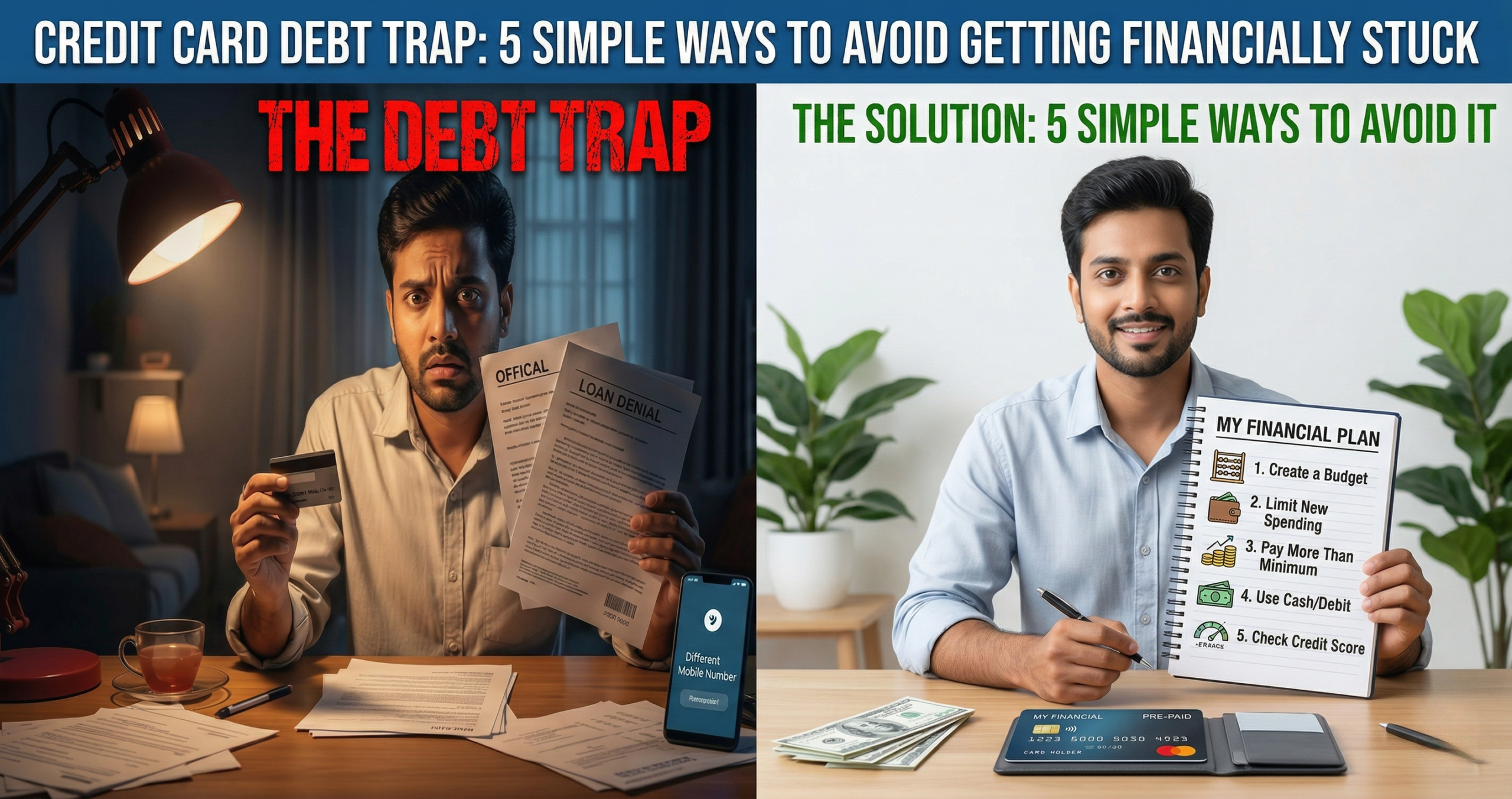
5 Smart Habits to Stay Out of Credit Card Debt
1. Your Credit Limit Is Not Your Budget
This is the most common mental mistake credit card users make.
Your bank gives you a ₹2 lakh credit limit. That does not mean ₹2 lakh is your spending budget for the month. It means the bank trusts you up to ₹2 lakh — which is very different from what you can actually afford to pay back.
Smart users keep their credit utilization below 30% of their limit. So on a ₹2 lakh limit, spending under ₹60,000 is the goal. This does two things: it protects your credit score (high utilization pulls it down), and it leaves room for actual emergencies — because emergencies don’t wait for your billing cycle to reset.
Think of your credit limit the way you’d think of a highway speed limit. The sign says 100 km/h. That doesn’t mean you should always do 100. Road conditions matter. Your reflexes matter. Same logic applies here — just because you can spend that much doesn’t mean you should.
2. The “Minimum Due” Is a Trap, Not a Lifeline
Every credit card statement shows two numbers: Total Amount Due and Minimum Amount Due. The minimum looks friendly — it’s usually 5% of the total, sometimes lower. Pay it and you avoid late fees. Sounds reasonable, right?
Here’s what the statement doesn’t say loudly: you’ll be charged 3–4% monthly interest (that’s 36–48% annually) on everything you didn’t pay.
Let’s say your outstanding is ₹50,000 and you pay only the ₹2,500 minimum. The remaining ₹47,500 starts attracting interest immediately — and at 3.5% monthly, that’s about ₹1,662 added in just one month. Do this for six months and the interest alone crosses ₹10,000.
The minimum due exists to keep you just comfortable enough to not panic. Don’t fall for it. Always pay the full outstanding amount before the due date. Always.
3. Small Purchases Are Where Big Debt Actually Begins
Ask anyone deep in credit card debt how it happened, and most won’t say “I bought a TV.” They’ll say something like: “I don’t even know. It was just a bunch of small things.”
That’s the quiet danger. It’s not the big-ticket electronics purchase that gets you. It’s:
- Ordering food delivery 4–5 times a week
- Buying stuff online without checking if you actually need it
- Subscribing to another streaming service
- “Just this once” becoming “just every week”
These transactions feel small because they are small — individually. But ₹300 here, ₹500 there, and a few ₹1,200 orders later, your monthly card spend has ballooned without you noticing. By the time the statement arrives, the total feels like it appeared out of nowhere.
Track these small expenses. Not obsessively, but at least enough to know where your money is actually going.
4. Set Your Own Spending Limit — Ignore What the Bank Offers
Your bank’s credit limit and your actual spending limit are two different things, and only one of them should drive your behavior.
Figure out what you can comfortably repay each month. If your income and expenses allow you to put ₹20,000 on a card and pay it fully at month end — that’s your limit. Whether the bank gives you ₹1 lakh or ₹3 lakh of credit, you stay within your own ₹20,000.
This sounds obvious but it’s genuinely hard to do in practice. A higher credit limit creates a psychological sense of space — it feels like you have more. That feeling is not real money. Run the card according to your budget, not the other way around.
Some people even call their bank and request a lower credit limit specifically to avoid the temptation. That’s a perfectly reasonable move.
5. Auto-Pay Is Useful But Don’t Let It Make You Lazy
Auto-pay is a good feature. It ensures you never miss a payment deadline, which protects you from late fees and credit score damage. Set it up — it’s genuinely helpful.
But here’s the thing: auto-pay is not a substitute for actually checking your statements.
When you stop looking at where your money goes, small problems grow into big ones. A subscription you forgot about. A duplicate charge. A fraudulent transaction. Or just the slow realization that your spending has crept upward month over month.
Check your credit card statement at least twice a month. Once mid-cycle, once near the billing date. It takes 5 minutes and it keeps you honest with yourself about your spending habits. Auto-pay handles the mechanics — you still have to handle the thinking.
Final Verdict: Credit Cards Are Fine. Your Habits Decide Everything.
The credit card itself is neutral. It doesn’t care if it helps you build wealth or buries you in debt. That outcome is entirely in your hands. Five habits. That’s all that separates a credit card that earns you rewards from one that charges you ₹15,000 in annual interest on purchases you can barely remember. Pay in full, stay within your own limit, watch the small expenses, and actually read your statements.
None of this is complicated. It just requires a little discipline — which, honestly, costs a lot less than 40% annual interest.
FAQs
You’ll avoid late fees, but interest (typically 3–4% per month) starts accruing on the remaining balance immediately. Over time, this compounds and you can end up paying far more than your original purchases. It’s one of the most expensive ways to borrow money.
Credit utilization is the percentage of your total credit limit you’re actually using. If your limit is ₹1 lakh and you’ve spent ₹40,000, your utilization is 40%. Keeping it below 30% is generally recommended for a healthy credit score.
Not inherently. A high limit can help your credit utilization ratio — as long as you don’t spend more just because the limit went up. The danger is psychological: more available credit can feel like permission to spend more.
Canceling a card can actually hurt your credit score (it reduces your total available credit and can affect your credit history length). A better approach is to cut back spending, set a personal limit, and possibly request the bank to reduce your credit limit if the temptation is too strong.
Most Indian banks charge between 2.5% to 3.75% per month, which works out to 30–45% annually. This kicks in on any balance you don’t pay by the due date — and on new purchases too, if you’re already carrying an outstanding balance.
Only if you set it to pay the full outstanding amount, not just the minimum. If your auto-pay is set to the minimum due, you’ll still be charged interest on the rest. Always check what your auto-pay is configured to pay.