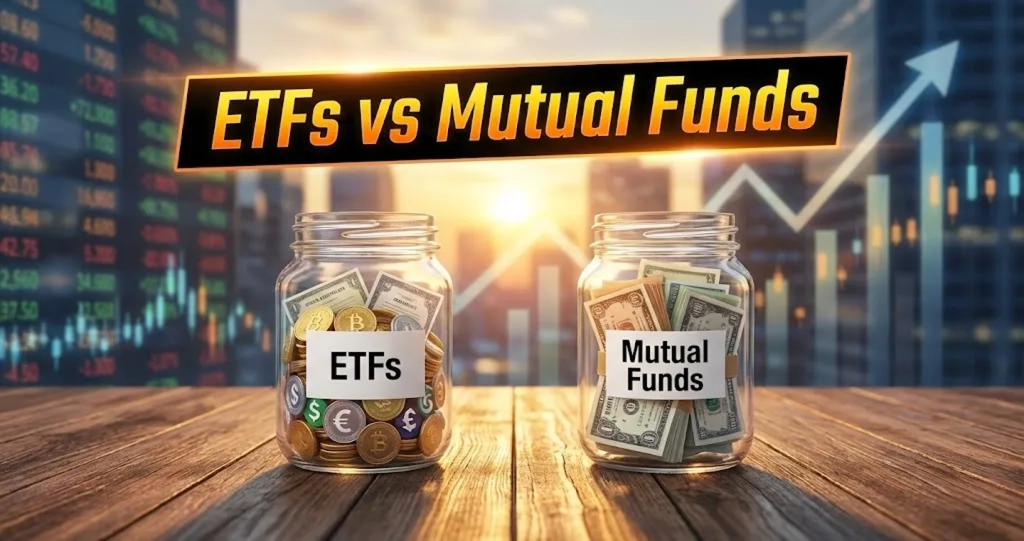
ETFs vs Mutual Funds: Picture this: Markets swing wildly thanks to global rate hikes and tech booms one day, then dip on election jitters the next. Sound familiar? In 2026, with investing apps popping up everywhere, more folks like you are dipping toes into Exchange-Traded Funds (ETFs) and Mutual Funds (MFs). But here’s the kicker—picking the wrong one can quietly eat your returns through fees or taxes. I’ve seen it firsthand: clients who switched to ETFs saved thousands in costs during volatile years.
This isn’t just a comparison; it’s your roadmap to smarter choices amid uncertainty. Why now? SEBI’s nudging lower costs, and passive funds like ETFs are exploding—perfect timing as inflation lingers around 5-6%. Let’s break it down simply, so you decide based on your goals, not hype.
What Exactly Are ETFs and Mutual Funds? No Jargon, Just Facts
ETFs pool investor cash to mirror an index, sector, or commodity—like the Nifty 50. You buy them on stock exchanges all day, prices ticking live like stocks. Want to sell at noon? Done. They’re mostly passive, tracking markets without fancy footwork.
Mutual Funds, on the flip side, gather money for a pro manager to pick stocks or bonds actively. You buy or sell at the day’s end Net Asset Value (NAV) through fund houses or apps—no intraday drama.
Logic check: ETFs feel like owning a share of the market party; MFs are like hiring a DJ to mix the playlist. Both diversify risk, but one’s hands-off, the other’s hands-on.

READ MORE: 4 Best SBI Mutual Fund Lumpsum Plan | Best SBI Lumpsum Plan 2026

ETFs vs Mutual Funds: The Head-to-Head Battle You Need
Costs kill returns faster than bad picks. ETFs shine with rock-bottom expense ratios (often under 0.2%), no sales loads, just broker fees. MFs? Higher expenses (0.5-2%) plus possible exit loads—ouch for quick moves.
Taxes hit different too. ETFs defer gains until you sell, rarely distributing them internally. Short-term? Slab rates. Long-term? 12.5% over ₹1.25 lakh. MFs tax on redemption and manager trades, so you might owe even if sitting tight.
Here’s the quick scorecard—straight from how they operate:
| Feature | ETFs | Mutual Funds |
|---|---|---|
| Trade Flexibility | All day on exchanges at market price | End-of-day at NAV |
| Liquidity | High—sell anytime markets open | Varies by fund rules |
| Management Style | Mostly passive | Mostly active |
| Expense Ratio | Low (minimal ongoing costs) | Higher (covers manager expertise) |
| Minimum Investment | Often one unit’s price (~₹100-500) | Lump sum/SIP minimums (₹500-5,000) |
| Tax Efficiency | High—gains deferred till sale | Lower—distributions from internal trades |
| Costs | Broker/DP/exchange fees | Operating expenses + exit loads |
Humor alert: ETFs are like a no-frills flight—cheap, on time, gets you there. MFs? Business class with perks, but your wallet feels the upgrade.
Why ETFs Might Be Your 2026 Power Move
Crave control? ETFs let you rebalance portfolios on a whim, no waiting for NAV. Low costs mean more money compounds—over 10 years, that 1% fee gap could mean lakhs extra. Tax-smart too: Hold long, pay less.
Ideal for: DIY investors building steady wealth. Think young pros eyeing retirement without fund manager egos. In volatile 2026? Their diversification cushions blows better than single stocks.
But watch: No active edge, so if markets tank, you ride it down.
When Mutual Funds Still Rule the Roost
Hand it to experts? MFs’ active managers hunt alpha—some beat benchmarks consistently, smashing inflation. Great for hands-free long-term goals like kids’ education.
Downsides? Less flexible, pricier, tax drags. Funny logic: Paying a manager is like tipping a chef for a home-cooked meal—you hope it’s worth it, but sometimes you could’ve grilled it yourself cheaper.
Best for: Busy folks or conservative long-haul planners. Evidence? Top equity MFs have delivered 12-15% CAGR historically, outpacing fixed deposits.
Who Wins? It Depends on Your Money Story
Your risk tolerance, time, and involvement call the shots. ETFs suit flexible, cost-conscious builders (short or long-term). MFs fit set-it-forget-it wealth chasers willing to pay for pros.
Future twist: By 2027, expect more ETF inflows as SEBI caps expenses further—could squeeze active MFs. Build a hybrid portfolio: 60% ETFs for core, 40% MFs for growth bets. Why matters now? With rates stabilizing, locking low-cost vehicles early beats waiting.
Pro tip from the trenches: Start small, track via apps like Groww or Zerodha. Review yearly—I’ve helped clients pivot mid-year to dodge tax hits.